Tuesday, August 2, 2022

Kotor - Tiny Town, Big Cruise Ships


Kotor's harbor, with the round Kampana Tower and city walls lining the Scurda River


Thursday, July 7 - Trip Day 8

Our tour bus dropped us at the port after our visit to Perast, so that we could visit the walled town of old Kotor.  One of the first things you notice when standing at the port are the city's defensive walls, which are anchored at the port by the large, round Kampana Tower.  The walls continue along the Scurda River and begin to climb up the lower slopes of Mount Lovcen. They stretch about 4 and a half meters -  built to their longest extent during Venetian times.

Kotor's story is similar to the rest of the Dalmatian walled cities:  Illyrians, Greeks and Romans, Justinian and Byzantia, Slavs, and Venetians from 1400 - 1700. Then rapid changes with Austria-Hungary, WWI, WWII and a terrible earthquake in the 1970s. This is not meant to trivialize the uniqueness of this bespendant location - it is the deepest indentation in the Adriatic Sea and a strategic location that was cherished. We spent about an hour on our tour of the old town - again in blistering high 90 degree heat.


Kampala Tower, and in the upper left, the city walls continue above

You can climb the walls to the Fortress in about an hour for 8 euro


The port arrival area is landscaped and well organized - clearly many cruise boats pass here

Three large cruise boats were in Kotor's harbor today - where do all the thousands of people fit?

The sea wall entrance to Kotor's old city

Venetian style carvings in the archway

Kotor's Clock Tower and the Square of the Arms

Restaurant under the Clock Tower - my location for lunch later in the day

The Pima and Bucha family palaces are located off the main square


The twin bell towers of the Cathedral of Saint Tryphon

Heavily damaged in earthquakes in 1660's and 1970's, but recently reopened after restoration


Reconstruction after the 1970s earthquake, using recovered materials where possilbe


It was hot, hot, hot.  Michael had peeled off from our tour once we entered another stone Cathedral and found a place to swim by the port.  Our tour was finished around 11:30, and I passed the Cafe San Giovanni as I walked back toward the port where our tender would take us back to the Sea Cloud.

The umbrellas were tightly packed, creating a wall of shade, with misting jets of air spewing out periodically.  People were drinking, laughing, relaxing at tables.  It was just too mesmerizing - I turned in and grabbed a table where I could sit, gulp water and Fanta, and watch the tourists walk by.

My waiter suggested calamari if I was interested in lunch - well, sure, I love calamari.  I called Michael - he was just about to leave on the tender, but walked back and joined me for lunch in the square.  Lush Greek salad for him, with big green olives and fresh, tasty tomatoes.  Great way to beat the heat.


Spur of the moment decision to have lunch in a cafe in the old town

Sporting a post-swimming hairdo, Michael surveys my array of hydration strategies...

Perfect Greek salad

Glad the waiter suggested the calamari - yummm!

After lunch, ready to take the tender back to the Sea Cloud

Doesn't she look pretty in the harbor?

A few quick photos (and a video below) of the Sea Cloud as we rode back on the tender


Perast and Our Lady of the Rocks

St George's Island (left) and Our Lady of the Rocks (right) - Perast, Montenegro


Thursday, July 7 - Trip Day 8

We arrived at our new port, Kotor, Montenegro, this morning about 7:30 AM, after a few hours transit through the Boka Kotorska.  We had a quick breakfast so that we could board the tender at 8 AM to take our buses for our first excursion - a visit to the town of Perast and the seaman's shrine of Our Lady of the Rocks.

The bus ride along the waterfront from Kotor to Perast follows the shoreline and takes about 40 minutes.  Along the way, we passed a number of oyster and mussel farms in the sea, as well as some turquoise blue swimming beaches.  From the bus, we could see the two islands that were our destination, Gospa od Skrpjeda - Croatian for Our Lady of the Rocks, and Svete Jurej, St. George's island.


Picturesque town of Perast

Boats for hire to take you to visit Our Lady of the Rocks

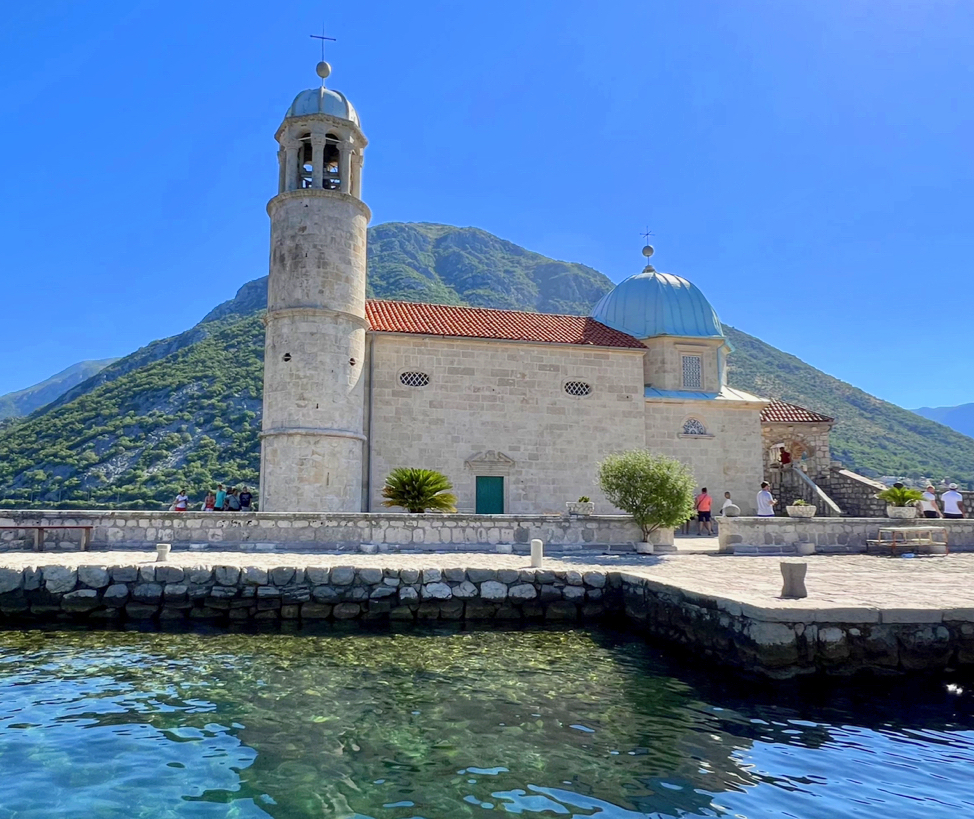
Completely man-made, built from piling rocks on a low lying reef over the centuries

Visitors are not allowed on the island of St. George, which houses a local cemetary

The Benedictine Monastery on St. George dates from the 12th century


Look below the water to see all the white rocks that have been collected to make the island

Our story begins on July 22, 1452, when the two fisherman, the brothers Morsic, discovered the painting of Mary, Our Lady of Perast, floating in the sea at the location of the current church.  They took it to their house, and one of the brothers was cured of an illness.  Word spread and to show their appreciation, the town built a shrine on the reef where the painting was found.

Over the years, it became known as Gospa od Skrpjeda, a shrine for seaman, as well as those who were sick or injured.  A tradition of bringing rocks to the shrine to build up the island has been ongoing for centuries.  The town of Perast holds a festival every July 22, the fasinata, launching their boats at sunset to throw rocks onto the island.


The large cruise ship, following us in the Bay, traverses the Strait of Verige

The church is built of stone from Korcula and dates from 1722

Church interior is decorated with oil on canvas scenes of sybils and the life of Mary

Inside the church, a row of silver votive plaques lines the nave, underneath the ornately decorated ceiling.  This row of panels contains thousands of silver plates that have been offered in gratitude for saving from storms, pirates and wars.  There were already more than 600 of these silver plates in the mid 1600's when it was documented that pirates stole them from the church.

The church also contains a small museum with additional paintings, textiles, manuscripts and art objects.  We also stopped in the town to visit the Perast Museum in the Bujovic Palace.


Detail of the silver votive plaques presented in gratitude for smooth sailing

A window and room in the church museum

Holding up the world outside of the church

A view of the Strait of Veringe from Perast


Oyster and mussel farms in the Bay of Kotor


Montenegro: the Spectacular Bay of Kotor


Sunrise on the Bay of Kotor

Thursday, July 7 - Trip Day 8

Early morning on the Bay of Kotor with a fierce wind making noise in the rigging:


Thursday, July 7 - Trip Day 8

This is the most beautiful morning of the trip.  I was up at 5 AM, because I wanted to see our journey into the Boka Kotorska - the Bay of Kotor.  As you can see on the map below, it's a complex body of water, which requires a convoluted set of turns. The bay is shaped like a butterfly or angel wings.  At the top, where the left wing is located on the map, is Perast and the shrine of Our Lady of the Rocks.  On the right, at the very end of the bay, is the town of Kotor - our next port of call.  We pass the narrowest opening, the Strait of Verige, to reach the two "wings" of the bay.

The sunrise occurred at 5:17.  We were in the first narrowing of the bay, near the town of Kumbor and headed toward Tivat.  I was in my favorite spot on the Sea Cloud - the foredeck.  Its location, just aft of the foremast and above the bridge, was a lofty perch from which to watch our progress.  I went there every morning - and almost always was alone.  To reach this perch, you must climb up a rung ladder attached to a wall, which probably discouraged a few from climbing to this perfect location.

Today, the wind was screaming in my face, coming fiercely from the wind tunnel formed by the narrow neck of water where the two peninsulas of land come together.  The sound of the wind in the rigging was so noisy it drowned out any other noises.  I could hardly hold my iPhone steady to take videos, as the wind was buffeting everything that posed any surface for resistance.  It was exhilarating.  I went back to the midship to grab a cup of tea and to wake Michael - this transit was a site not to be missed.  Ironically, when I looked astern, there was a huge cruise ship following us in - at a respectable distance.   I don't think two  of those cruise ships can pass through the narrow Strait of Verige approaching Perast at the same time. Too tight.


Map of the Boka Kotorska and our location for the next few photos below

Montenegro means "black mountain" - thought to be called so because of the dark pine forests

Sharing this fun morning with Michael and some coffee and tea

A submarine docking location carved in the mountain from Yugoslavian times


Approaching the narrowest channel of this "fjord" - the Strait of Verige

Once through these narrows, the bay opens its wings to the left (Perast) and the right (Kotor)

Multiple sunrises, as we ducked behind the shadows of various peaks along the peninsulas

Large cruise ship following our path; Church of St. Nicholas on right


As we passed through the ferocious wind tunnel formed by the narrow opening at the top of the bay, the sunlight streamed down the mountainsides.  In front of us, blocking the sun still in places, was Mount Lovcen and the town of Kotor at its base to the right.  Mount Lovcen rises 5,738 feet above the bay and is the inspiration for the name of Montenegro (Crna Gora or Black Mountain).  It is part of the Dinaric Alps, which cover this section of the Balkan peninsula

The seaside town of Perast was in front of us, and on our left, the man-made island with its sailor's shrine, Our Lady of the Rocks.  To its right, the natural island of St. George, with it's Benedictine Monastery.


The islands of Our Lady of the Rocks and St. George


Sunny and way less windy now that we're through the straits

The town of Perast, also in the video below:


Approaching the port of Kotor

Morning sun streaming over Kotor and St. Matthias church

Our anchorage in Kotor - and a large cruise ship in port

The medieval city walls and fortifications climb the lower slopes of Mount Lovcen above Kotor